OEE
87%
▲ 6%
Running
24
of 28
Downtime
2h 15m
▼ 18%
Alerts
3
attn
P1
Palletiser 01 — Running
98%
CP
Case Packer 02 — Warning
74%
RC
Robot Cell 04 — Faulted
32%
Machine Pilot turns the operational IP scattered across your plant — PLC code, SOPs, OEM manuals, and the know-how locked in your senior operators' heads — into one source of truth. Access all of it through the Machine Pilot terminal: ask in plain language, get answers grounded in your own documentation and cited every time. Operators get help in seconds, and the knowledge stays in the business when people move on.
Turn decades of tribal knowledge, manuals, PLC logic, SOPs and maintenance procedures into one searchable intelligence platform — so it stays in the business when people move on.
Give every operator and technician instant, sourced answers to troubleshoot, operate and maintain equipment — cutting the escalation chain and defending the shift.
Machine Pilot grows with your plant, continuously learning from new documentation, approved improvements and operational experience — a factory that gets smarter every shift.
No rip-and-replace and no new hardware. Machine Pilot layers onto the documentation you already have.
Drop in your PLC exports, SOPs, OEM manuals and electrical drawings. Machine Pilot indexes them into one searchable knowledge base, scoped to your plant and your machines.
On any phone, tablet or HMI panel, an operator describes the fault in their own words — or snaps a photo of the HMI screen. No training and no query syntax.
Machine Pilot returns the likely cause and a clear, ordered recovery — with the exact source it came from. Answers in seconds, never a generic guess.
An operator asks in plain language. Machine Pilot replies with a clear, ordered fix and the exact source it came from — never a generic guess.
The right information is usually somewhere on site — in a senior operator's head, in a PLC nobody touches, in a manual that was last opened five years ago. Machine Pilot centralises it and puts it in the operator's hands the moment they need it.
Every senior operator who leaves takes years of plant-specific knowledge with them. Machine Pilot centralises that knowledge so it stays — turnover stops costing you uptime, and new starters don't fumble through faults their colleagues solved in minutes.
Escalating for help takes too long — sourcing the right information from the right person, while the SOP manual was lost years ago. Now, for the first time, every source of knowledge is consolidated and presented in seconds.
Without a fast, trustworthy second opinion, operators try the same five fixes in different orders — and trial and error usually makes things worse. Clear, correct instructions, grounded in your machine's own data, eliminate the guesswork. Lost production costs $15K–$80K+ per day; that's the line being defended.
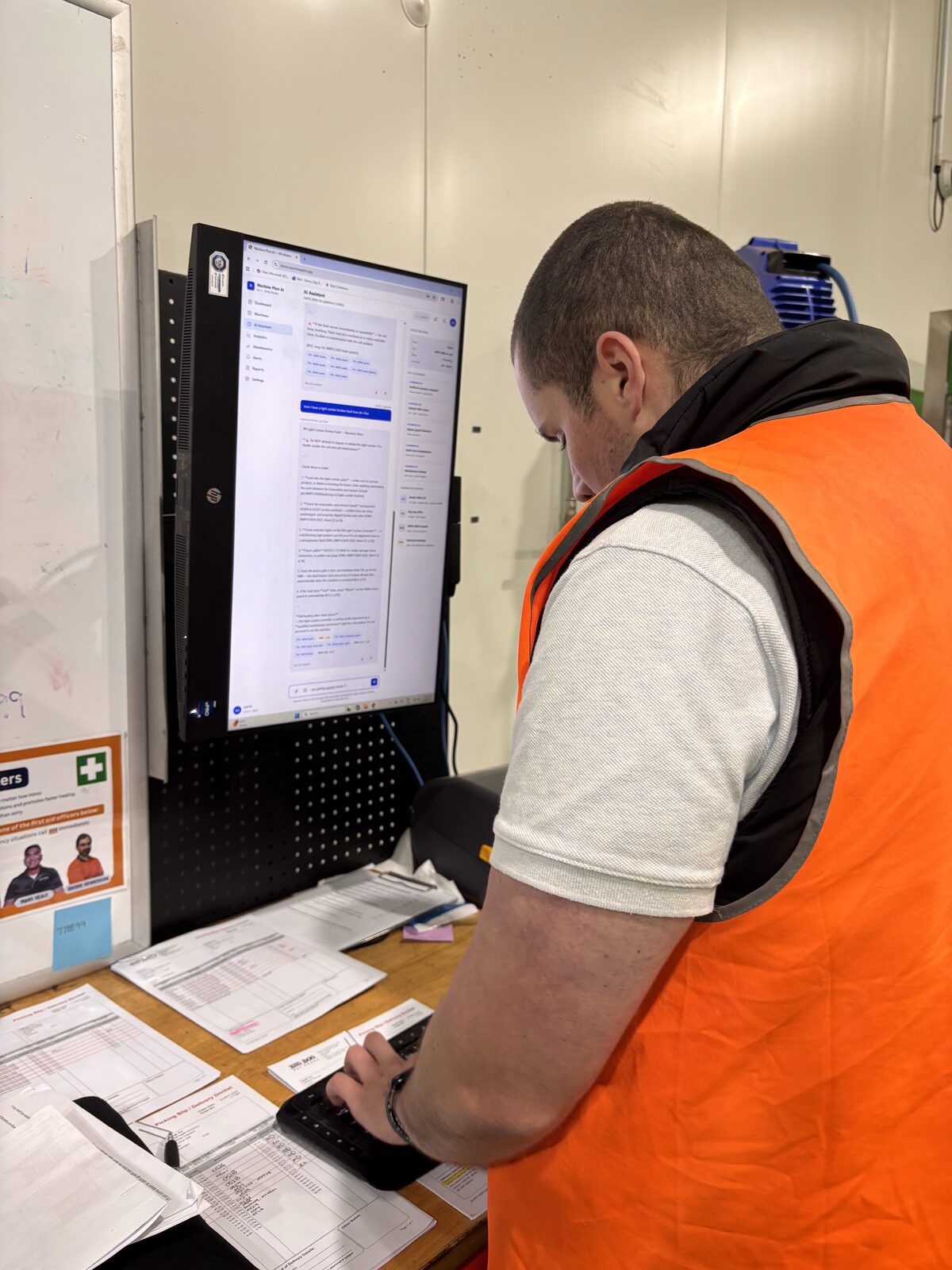
Machine Pilot isn't a dashboard for head office. It's a second opinion in the hands of the operator, the technician and the maintenance lead — right where the work happens, the moment a fault stops the shift.
Machine Pilot doesn't guess. Every answer is built from your operation's own knowledge, in a disciplined order: your equipment's own logic and data first, your documented procedures next, then manufacturer documentation. Where sources disagree, the conflict is surfaced — not hidden. The same discipline scales from a single-machine pilot to a multi-site enterprise deployment.
PLC exports, SCADA tags and historian data are ingested and mapped to specific tags, rungs and routines, so answers are grounded in how your machine actually works — not a generic guess. Live integration to your control systems is available where the operation needs it.
Standard operating procedures, work instructions, cleaning and changeover routines. Versioned, retrievable, and indexed in your plant's own vocabulary.
Structure-aware chunking of OEM manuals. Vision-captioned electrical drawings. Indexed by section, page, and component, so a citation always lands on the right place.
Machine Pilot isn't a generic chatbot dropped onto your shop floor. Every deployment is configured around your specific equipment, processes and people — without rewriting the platform. You get a tailored licence; we maintain the engine underneath it. The result is enterprise-grade AI that speaks your plant's language.
Your manuals, SOPs and PLC exports are loaded into a tenancy that's strictly yours. No co-mingling, no cross-customer learning, no shared embeddings.
System prompt extensions teach the engine your terminology, your escalation paths, and your role-based behaviour — without weakening any of the platform's safety rules.
Response style, level of caution, language, depth of citation — configurable per tenant. The same model, tuned to fit how your operators actually want to be spoken to.
White-label option, your SSO, your audit log routing, your dashboards. The platform plugs into the systems your team already uses.
The features that matter on a plant floor — citations, safety refusals, multi-source reasoning, audit trails — are first-class. Not bolted on.
Inline citations to section, page, PLC tag, and routine. Operators can verify, supervisors can audit, suppliers can trust.
Hard refusals on guard bypass, interlock defeat, or any safety-rated override — built into the base prompt, not toggleable by configuration.
One question can pull from PLC, SOP, manual, and drawings in a single answer — and flag where they disagree.
Each customer's corpus, system prompt, and model behaviour is configured per tenant. One platform, many plants — no data ever crosses.
Every operator turn, model decision, and source citation is logged. Supplier audit, plant management reporting, regulatory traceability — all out of the box.
Operators interact on the screen they already use — and the terminal is fully mobile-responsive today, so it works on the phone in their pocket on the floor. A dedicated mobile app is on the roadmap, with WhatsApp and Slack adapters that drop in without changing the engine.
When your SOPs change or a new procedure is approved, drop the updated file into your customer portal — drag, drop, indexed. The next operator question sees the new procedure. No code change, no engineering ticket, no waiting.
The platform meets your operation where it is today and grows as your automation, data and people mature. A site with paper SOPs and tribal knowledge starts seeing value in week one; a fully PLC-instrumented multi-site group gets the same engine with deeper grounding, central oversight, and consistent answers reaching everyone — from the operator on the line to the supervisor at the production meeting to the CEO reviewing OEE.
Paper SOPs, OEM manuals, and the tribal knowledge in your senior operators' heads. Captured, indexed, and made answerable in week one. Add PLC ingestion later as your data matures — no replatforming.
Several machines on one site, mixed automation, mixed vintages. PLC + SOP + manual + drawings ingested for each asset. Plant-specific prompt tuning, integrated maintenance schedules, supervisor-level analytics.
Many plants, central tenancy and audit, per-site configuration, SSO, and exec-level reporting. The same engine reaches operators, supervisors and executives with answers grounded in each site's own data.
Operators get answers. Maintenance gets context. Plant managers get visibility. Everyone gets the audit trail.
One platform, three tiers, transparent metering. All tiers ship with citation grounding and safety refusals — they're not premium features.
Customer / OEM documents are sensitive. We treat them that way from day one — encryption, tenant isolation, hard safety rules, and Australian hosting where you need it.
Per-tenant API keys with tier scoping. No cookie sessions, no shared credentials, no auth surprises.
Every database row carries a tenant_id. Every query filters by it. Customer A never sees Customer B's documents, fault logs, or system prompt.
The safety refusals are in the base system prompt. Tenant configuration can extend, never weaken. AS 4024 / ISO 13849 aware.
Every operator turn, every model decision, every cited source — logged with timestamps. Supplier and regulator-ready.
Hosted on DigitalOcean Sydney (SYD1). No data leaves the country unless you explicitly extend to a multi-region deployment.
TLS 1.3 for all traffic, AES-256 at rest for conversation logs and ingested documents. Secrets managed in the DO App Platform vault.
Generic chatbots hallucinate. Machine Pilot is wired into your specific PLC, SOPs and OEM manuals — every answer it gives is grounded in your machine's own documentation, with citations. The model is also configured to refuse any request that would compromise safety (e.g. bypassing an interlock), which generic chatbots do not enforce.
The platform runs in a "manuals and SOPs" mode until the PLC export is available, and clearly tells operators when a question would benefit from PLC context that isn't yet ingested. When the L5X export arrives from your OEM, ingestion is a single job run — no code change.
For an existing customer adding a second site: drop the new site's documents into their cloud folder, add a tenant row with site-specific configuration, run the ingestion job. Typically under one hour of work. For a brand-new customer: a kick-off call to map their documentation, then 1–2 weeks to first operator demo with their real corpus.
The system prompt is hardened to require source attribution on every factual claim. If the retrieved chunks don't cover the question, the model is instructed to say so and ask a clarifying question — not to invent fault codes, tag names, or procedures. We monitor citation accuracy as a first-class quality metric.
Yes. The API is the product. The browser / tablet wireframe you see in the demo is one interface; Slack, WhatsApp, and embedded-in-your-own-dashboard integrations all hit the same /ask endpoint. The roadmap covers Slack escalations in Phase 2 and WhatsApp field-tech mode in Phase 3.
You do. The conversation logs and ingested documents belong to you. We use the platform's logs to improve quality on your tenant only — never to train models that other tenants benefit from. Enterprise tier includes a contractually scoped data-use clause.
Drop the new files into your customer portal — drag, drop, indexed. The platform re-ingests automatically and the next operator question sees the updated content. For PLC L5X changes, the same one-job ingestion pipeline catches the new tag definitions and rung logic. No engineering ticket, no code change, no waiting on us. Your plant team owns its own knowledge updates.
Pricing is per machine, per month, on a volume-tiered basis — the more machines you bring on, the lower the per-machine rate, with bespoke pricing for large fleets. We start most customers on a scoped pilot so you can prove the value on your own line before committing. See the pricing tiers above, or book a demo for a quote against your machine count.
Your corpus and conversation logs are hosted in Australia (Sydney region) with encryption in transit and at rest. Every customer is a separate tenant — retrieval, dashboards and logs are scoped so one customer can never see another's data, and that isolation is enforced at the database and API layer, not just the UI. You own your data; we never use one tenant's content to benefit another.
It's brand-agnostic. Machine Pilot works from whatever documentation a machine has — OEM manuals, SOPs, electrical drawings and setup sheets — from day one, regardless of make. For deep PLC-grounded answers it ingests the controller export (e.g. Rockwell Studio 5000 / L5X); other control platforms are added as their exports are supplied. If a machine has documentation, it can be onboarded.
Any browser — a phone, a tablet, or the HMI panel on the line. There's nothing to install. Operators can type a fault in plain language or snap a photo of the HMI/fault screen and get a grounded, cited answer in seconds. Because the API is the product, the same answers can also surface inside tools you already use.
Every factual answer is grounded in your own documentation and cited, and the model is configured to refuse anything that would compromise safety — it will never help bypass an interlock, guard or e-stop. It's a decision-support tool, not an autonomous controller: the operator remains responsible for safe execution and follows your plant's standard procedures. We track citation accuracy and resolution outcomes as first-class quality metrics so accuracy is measured, not assumed.
We're booking 10-minute discovery calls with plant managers and OEMs through May–June. Walk us through one of your machines, see Machine Pilot answer a real question from your documentation, decide if it's worth a pilot.